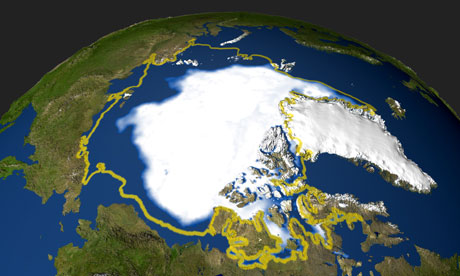
After a study done by the Arctic Monitoring and Assessment Program, scientist now believe that snow and ice in the Arctic are melting much faster than expected. The study shows that for the past six years, temperatures in the Arctic have been the highest recorded since measurements began in 1880. The ice coverage on the Arctic Ocean has been shrinking extremely quickly, so quickly that scientist now predict that there will be no summer ice in forty to fifty years. Sea levels are now expected to rise faster, with the new projection being 35 to 63 inches by 2100. I personaly believe that this study should be taken seriously, due to the havoc no summer ice could cause Arctic animals, like the polar bear which would not be able to find enough food to survive, or seals, which will not have ice to raise pups on. Rising sea levels will also affect coastal towns around the globe. A simple solution is to, raise public concern on global warming, and to increase research on preventive measures.
http://www.huffingtonpost.com/2011/05/03/arctic-melting-sea-levels-climate-change_n_856924.html
Monday, August 20, 2012

Sunday, August 19, 2012
Green; Legal Fight Over Arctic Drilling
http://query.nytimes.com/gst/fullpage.html?res=9A06E1DD123CF933A25754C0A9649D8B63&ref=alaska
A vast amount of environmental safety groups are rallying against Shell as they prepare to begin offshore drilling. In fact, they are filing a lawsuit challenging Shell to respond to how they plan on dealing with the situation of a potential oil spill. The Interior Department’s Bureau of Safety and Environmental Enforcement approved Shell with their plans to “cap a runaway well and clean up any spilled oil.” In their defense, they meet regulations on drilling safety according to department officials. However, environmental advocates declare that Shell has no plan of action to care for the endangered wildlife or shorelines! Currently, no technology has been 100% effective at cleaning up oil spills. Shell has filed a lawsuit to pre-empt litigation from environmental activists, this has been ineffective, but both sides plan to attend court in Anchorage. Possible solutions to this issue would be coming up with technology that could assist people in cleaning up oil spills. Another solution would be taking preventative measures on equipment, with extra research on drilling locations, so that there would be less of a chance of oil spill. Barriers to these solutions do exist. Technology is not always made available and deep studies into ocean floors aren’t always predictable. Personally, I believe both sides of the argument are valid. If we do not care for our environment now, we will pay for it later on. In contrast, oil is almost a necessity now-a-days; we use it for cars, stoves, lawnmowers, and heaters. The simplest solution would be to find an alternative fuel source that won’t bankrupt any other department. Oil is not a renewable resource!
A vast amount of environmental safety groups are rallying against Shell as they prepare to begin offshore drilling. In fact, they are filing a lawsuit challenging Shell to respond to how they plan on dealing with the situation of a potential oil spill. The Interior Department’s Bureau of Safety and Environmental Enforcement approved Shell with their plans to “cap a runaway well and clean up any spilled oil.” In their defense, they meet regulations on drilling safety according to department officials. However, environmental advocates declare that Shell has no plan of action to care for the endangered wildlife or shorelines! Currently, no technology has been 100% effective at cleaning up oil spills. Shell has filed a lawsuit to pre-empt litigation from environmental activists, this has been ineffective, but both sides plan to attend court in Anchorage. Possible solutions to this issue would be coming up with technology that could assist people in cleaning up oil spills. Another solution would be taking preventative measures on equipment, with extra research on drilling locations, so that there would be less of a chance of oil spill. Barriers to these solutions do exist. Technology is not always made available and deep studies into ocean floors aren’t always predictable. Personally, I believe both sides of the argument are valid. If we do not care for our environment now, we will pay for it later on. In contrast, oil is almost a necessity now-a-days; we use it for cars, stoves, lawnmowers, and heaters. The simplest solution would be to find an alternative fuel source that won’t bankrupt any other department. Oil is not a renewable resource!
Mining in the Arctic
Mining in the Arctic
The idea of mining in the Arctic has been thrown out a long time ago because of the large amounts there making it hard to mine. In the Arctic the ice caps are melting; therefore making it much easier to get to the minerals in the soil. Dennis Thomas of Thomas mining associates see the ice melt as a great opportunity for them. He hopes to see half a dozen mines there. Other people are hopping on the bandwagon too. Other countries such as china are also planning to mine there. There are new mining applications being submitted to many places in the arctic like Greenland an Finland. Laws against mining are being repealed, and licenses to extract radioactive elements like uranium and thorium are being given out.
 Although mining benefits the mining companies, it threatens the nearby Bristol Bay watershed. The nearby Bristol Bay watershed supports the world's most productive wild sockeye salmon fishery. Without it there is no say as to what may come of the Alaskan native communities. They live off of salmon! The only mining operation happening right now in Greenland is the Nalunaq gold mine in the South country. This isn't an issue because it has created jobs, but the larger plan for mining is what may cause destruction. The solution to this problem would be for someone to step in and limit the amount of mining there, but it seems as if that won't happen. The people in power there seem to like what will come of the mining, like wealth. If the natives speak up then maybe someone will see an opposition to the mining. I personally think that the world is selfish. They use and use and don't give anything back. They have mined so much everywhere else that they need a new spot to mine. This is the way it always is, and they do not give back. Mining would affect the natives of the arctic and the animals there. I think that people should see the ice caps melting as a negative thing, and NOT a positive one. All they care about is making money. If people a few companies start to mine there, then more will after. Then the issue with the arctic will not be able just saving the animals from the icecaps melting and the changes the heat has on them. It will be about their homes being dug up all around them.
This is the site where i got the article from.
http://www.guardian.co.uk/environment/2011/jul/04/ice-caps-arctic-white-gold-rush?intcmp=239
by Allyson Beetham
The idea of mining in the Arctic has been thrown out a long time ago because of the large amounts there making it hard to mine. In the Arctic the ice caps are melting; therefore making it much easier to get to the minerals in the soil. Dennis Thomas of Thomas mining associates see the ice melt as a great opportunity for them. He hopes to see half a dozen mines there. Other people are hopping on the bandwagon too. Other countries such as china are also planning to mine there. There are new mining applications being submitted to many places in the arctic like Greenland an Finland. Laws against mining are being repealed, and licenses to extract radioactive elements like uranium and thorium are being given out.
This is the site where i got the article from.
http://www.guardian.co.uk/environment/2011/jul/04/ice-caps-arctic-white-gold-rush?intcmp=239
by Allyson Beetham
August 19, 2012
People of the Arctic
People have populated the arctic for thousands of
years. They most likely followed their
game north from Central Asia and adapted to the environment. The most widespread people of the region are
known as the Inuit. They are found in Alaska, Canada, Greenland, and
Siberia. Most of the tribes either herd,
fish, or hunt for a living but now that the area is being explored for natural
resources, they are being trained for more advanced occupations like farming
and mining. All of the Arctic people have adapted to survive in the Arctic
terrain with such little resources at their disposal which makes their culture unique to the rest of the world's.
Friday, August 17, 2012
No Ice in the Arctic?
A problem that the Arctic is facing is that more ice in the
region is melting in the summer then forming in the winter, resulting in the
reduction of the thickness and amount of the Arctic's ice. The European Space
agency has hypothesized that at the end of the decade all the ice in the arctic
will melt in the summer months, based on their preliminary data. The ice melt
rate is suggesting that global warming is increasing in severity of effects on
the Arctic Regions. Because of the main problem of ice loss, many other
potential problems are stemming off. By losing the ice, the temperature of the
region could rise more, because more sunlight would be absorbed by the
"darker" oceans. Methane deposits on the floor of the ocean could
also melt and enter the atmosphere as a vapor after evaporating. Glaciers, like
the ones around Greenland, would be at a higher risk of melting and raising the
sea levels faster than said levels are currently. There is also a worry that
the disappearance of the ice will cause many industries, such as fishing and oil drilling, to move into the area.
In my opinion, I think that the ice in the Arctic could
eventually melt completely, but it is going to take longer than by the end of this decade, at least several decades. The data that the prediction in the article was based
did not include some factors, such as the weather, as well as temperatures, differ every year. While the prediction is not unfounded, I think that it is
unrealistic and needs to be altered. I do not understand the severity of some
of these other problems since the article did not really elaborate on them,
though I think some are worrying that industries will move into the area
because they think these industries will hurt the environment or alter it further, which I agree with. Using history as a reference, there is a good possibility that something like an oil spill could occur if oil drilling began there, or a species of animal living in the arctic waters could become endangered because of poaching or overfishing.
There were not any
suggested solutions, or barriers for solutions, included in the article, so there was not anything specific that I could form an opinion on. I do not think that it is possible to stop
the ice from melting, though the rate of ice melt could possibly be slowed down
a little bit. On how to accomplish this, I have no real idea.
BBC News - Arctic sea ice 'melting faster'
Studies are showing that Arctic sea ice is melting at increasing rates. The European satellite, Cryosat, measured that ice thickness dropped from 5-6m to 3m in a decade. Annual ice loss was thought to be close to 900 cubic km a year in a 2004 study. Even though ice loss estimates vary, research shows that the Arctic sea ice continues to decrease at alarming rates. Satellites and scientists have proved that the Arctic is warming much faster than the rest of the planet. The sea ice reflects heat back into space. If this did not happen, the heat would get absorbed into the water beneath it. This would heat up the atmosphere and cause climate change for the entire planet. If the sea ice was to disappear completely, sea levels would rise immensely. It is difficult for scientists to determine the true cause of the sea ice continuing to melt, so it is hard to find a solution. Some say that ice loss is manmade, and others argue that it is natural. I think the Arctic ice loss is a serious problem that is going to be difficult to stop. I hope that scientists can figure out a way to reverse the effects soon, or the planet could have even bigger challenges ahead.
http://www.bbc.co.uk/news/science-environment-19244895
Monday, August 13, 2012
Rapid Changes for Arctic Flora and Fauna
Over the past decade, research has shown that there has been a rapid decrease in sea ice, tundra, lakes and peatlands. In 2008 a decree was passed by The United Nations Environment Program which expressed its concern of the dwindling tundra. Some of the points the report introduced was the fact that the animals and people were being majorly affected by the climate change. Polar Bears are one of the chief animals that are affected. The polar bears are equipped to live on the sea ice; but with the climate change, their habitat is thinning and melting away. With the warming climate, foreign plants are beginning to take root farther north and replacing currently residing plants. Trees are also being seen further north and the results show that fifty-one percent of the tundra will be taken over by trees. With the climate warming, the permafrost is retreating. Coral reefs are a habitat for fish and other sea life and are in danger by human interference such as fisheries, gas and oil explosions. Overall, with the climate change and human interferences the current animal and plant residents may not survive in the future.
My
opinion on this is that yes the climate may be getting warmer; but that’s just
what the weather does, it changes. What I
think the best thing to do would be to make the residents well aware of what is
happening to the tundra and cut down on heat release to try to maintain as much
a normal climate as possible. Looking at
the aquatic side of climate change, mark off the coral reefs so the fisheries
are well aware of where they are so they can prevent damage. As a whole, what
is happening is just an act of nature.
They cannot control the weather and temperature but they can make
themselves knowledgeable of how to make less of an impact on the land.
Subscribe to:
Posts (Atom)